In Japan, most tech companies hire new graduates as a cohort. They all start in April and spend one to four months in company-run training before joining a team. Every spring and summer, many of these companies publish the slides, repositories, and write-ups from that training.
This article goes through what 44 of them have published and tallies their curricula by subject area.

Each bar shows how many of the 19 companies with a fully documented curriculum teach that area as a dedicated subject. Cloud and infrastructure leads with 17, followed by web applications and databases.
How the curricula are built
These are the 19 companies whose most recent curriculum (2023 to 2026) is documented in full. For each area, the bar shows how many of them teach it as a dedicated subject.
Core technologies
- Databases & SQL14 / 19
- Git13 / 19
- Programming languages10 / 19
- Linux & shell6 / 19
Application development
- Web applications15 / 19
- Testing & QA10 / 19
- Design & architecture8 / 19
Infrastructure, operations, and security
- Cloud & infrastructure17 / 19
- Security12 / 19
- Containers8 / 19
- Networking4 / 19
Process and generative AI
- Mindset & writing13 / 19
- Team project (PBL)13 / 19
- Generative AI11 / 19
- Development process7 / 19
The count reflects whether an area has its own dedicated subject. An area without one may still be covered elsewhere. Some companies have no "Linux" subject, for example, but their container training has trainees run unshare and ip addr.
How deep Git training goes
Five companies publish their Git material in enough detail to see what it covers. The steps below show how far each goes.
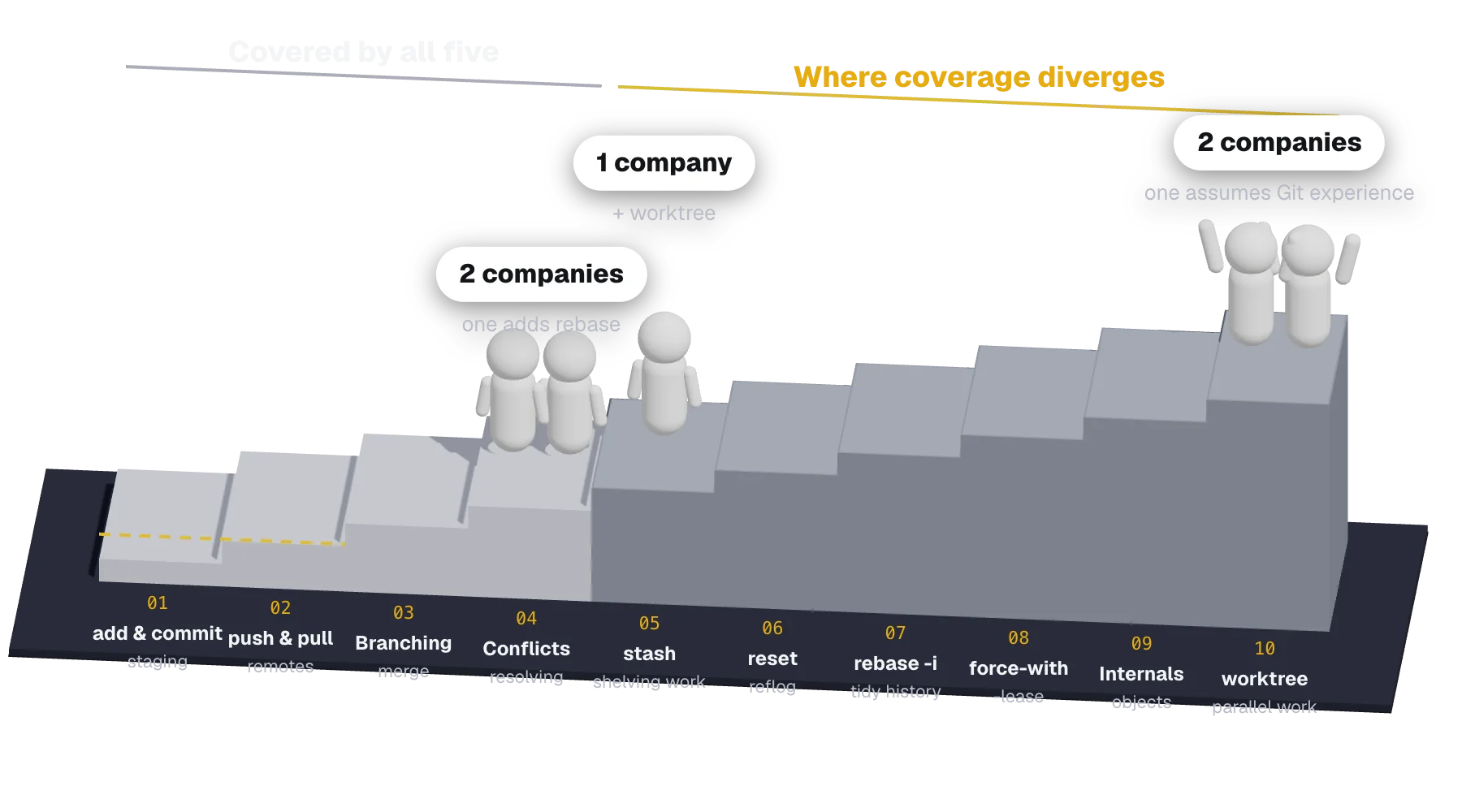
All five cover everything up to resolving conflicts. Where they diverge is recovery with reset and reflog, tidying history with rebase -i, and internals such as the object model.
- The company with the widest coverage spends a full day on Git and goes as far as recovering with
reflog,rebase -i, and reading.git/objects - The company that designs its course for experienced developers states that it is aimed at "people who have already done some development with Git," and treats the basics as a given
Few companies teach Linux and the shell as a subject
Only 6 of the 19 have a dedicated subject for it, and the material of two is published in detail. One of them, a course on server operations, has trainees SSH into a training server and work all the way up to investigating logs.
One exercise asks trainees to "show only the source IP addresses that have ever logged in to the server, without duplicates" (translated from Japanese). The answer is a single line of piped commands. Here is the same idea run against a file of login records:
Companies without a dedicated subject still write the rest of their material assuming command-line skills. Their container courses and the setup guides for their AI courses expect trainees to work in a terminal. The shell is treated less as something to teach and more as a prerequisite for everything else.
The basics are becoming prerequisites
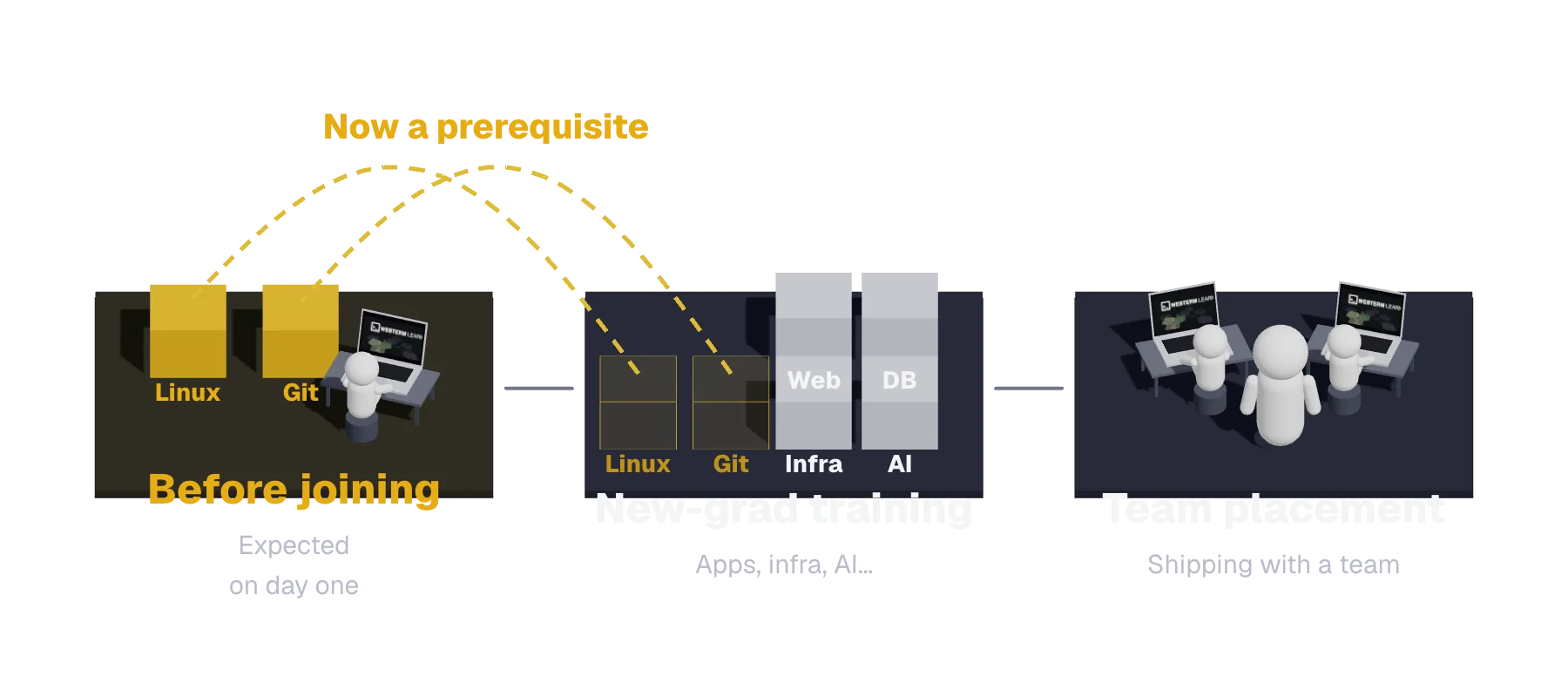
Some training programs and materials now state basic shell and Git skills as a prerequisite. The quotes below are translated from Japanese.
“Terminal: can change the working directory, create files, run commands, read error output, use multiple terminals, and stop a process with Ctrl-C.”“Git: can use clone, status, diff, add, and commit.”
Prerequisites in the README of Speee’s training material “training-web-app”“This is aimed at people who have already done some development with Git.”
Cybozu 2026 new-hire training, “Git tips worth knowing,” p. 3“Based on a skills assessment taken before joining, trainees were split into classes by proficiency and level of understanding.”
Recruit, 2026 training report (written by a new graduate who took it)“We designed time for self-study between sessions, but some trainees had already done the self-study we had planned.”
Cybozu, “Behind the 2026 engineering new-hire training” (by the organizers)
The published course lists point the same way. Linux and Git courses disappeared from Cybozu's list in 2020 and from Recruit's in 2025. (Both companies also run internal or unpublished courses, so this does not prove they stopped teaching them.) As the range of skills among new hires widens, some companies appear to be moving to a model where the basics are expected on day one and training is split by proficiency.
Databases: design and performance over writing SQL
Six companies publish their database material in enough detail to see what it covers. The bars show how many cover each topic.
- Writing SQL4 / 6
- Schema design4 / 6
- Performance tuning6 / 6
- Transactions3 / 6
- Choosing a database3 / 6
All six cover performance tuning. Writing SQL is where they split: one company has trainees write a hundred queries, while another states at the outset that its database course does not cover how to write SQL.
Three approaches to generative AI
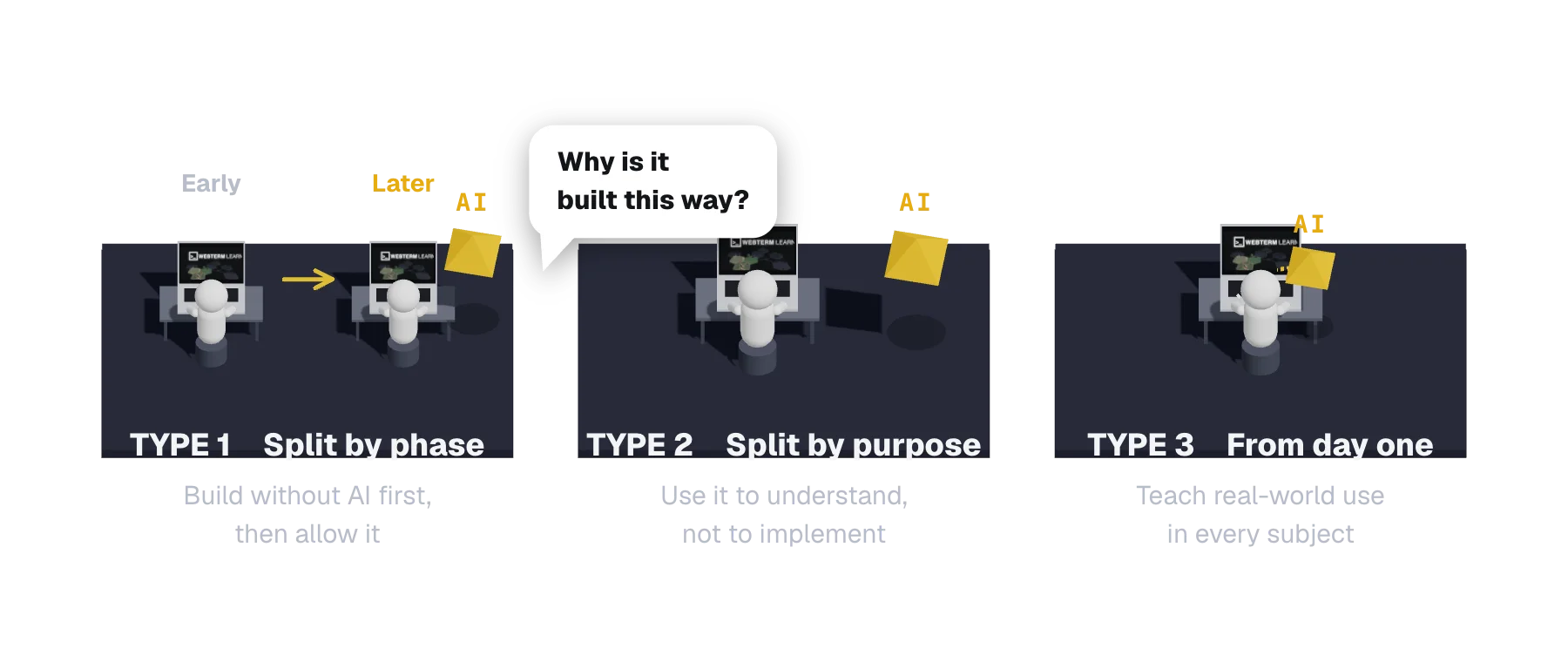
TYPE 1
Split by phase
Implement without AI first, then allow it later.
Bengo4.com
“Generating code with tools like Claude Code was banned until partway through.” “From team project (2), AI was finally allowed.”
2026 training report by a new graduatefreee
“No AI! Building a web browser: 4 weeks,” followed by “All-in on AI! Themed product development: 5 weeks.”
2025 new-graduate training reportTOKIUM
After a four-day Claude Code course, the Rails training said: “Don’t use Claude Code for the coding.”
2026 training report by a new graduate
TYPE 2
Split by purpose
Use it to understand, not to implement.
Recruit
“Use it for understanding, not for doing the work.”
2026 modern front-end course, p. 7Speee
AI is “not the implementer” but “an explainer and a sounding board.”
README of the training material “training-web-app”
TYPE 3
From day one
Teach real-world use inside every subject.
MIXI
“We ask instructors to show how they themselves use it.”
2026 new-graduate training press release (comment by the CTO)Cybozu
Runs a lecture on AI-assisted coding, and “this year’s new graduates took on ‘AI-driven development’ in the hands-on project.”
2026 engineering new-hire training report (by the organizers)
“To use AI effectively, the foundational knowledge and design skills needed to judge whether generated code, SQL, and designs are sound matter more than ever.”
MIXI, published write-up of its 2026 new-graduate technical training
Problems reported in training retrospectives
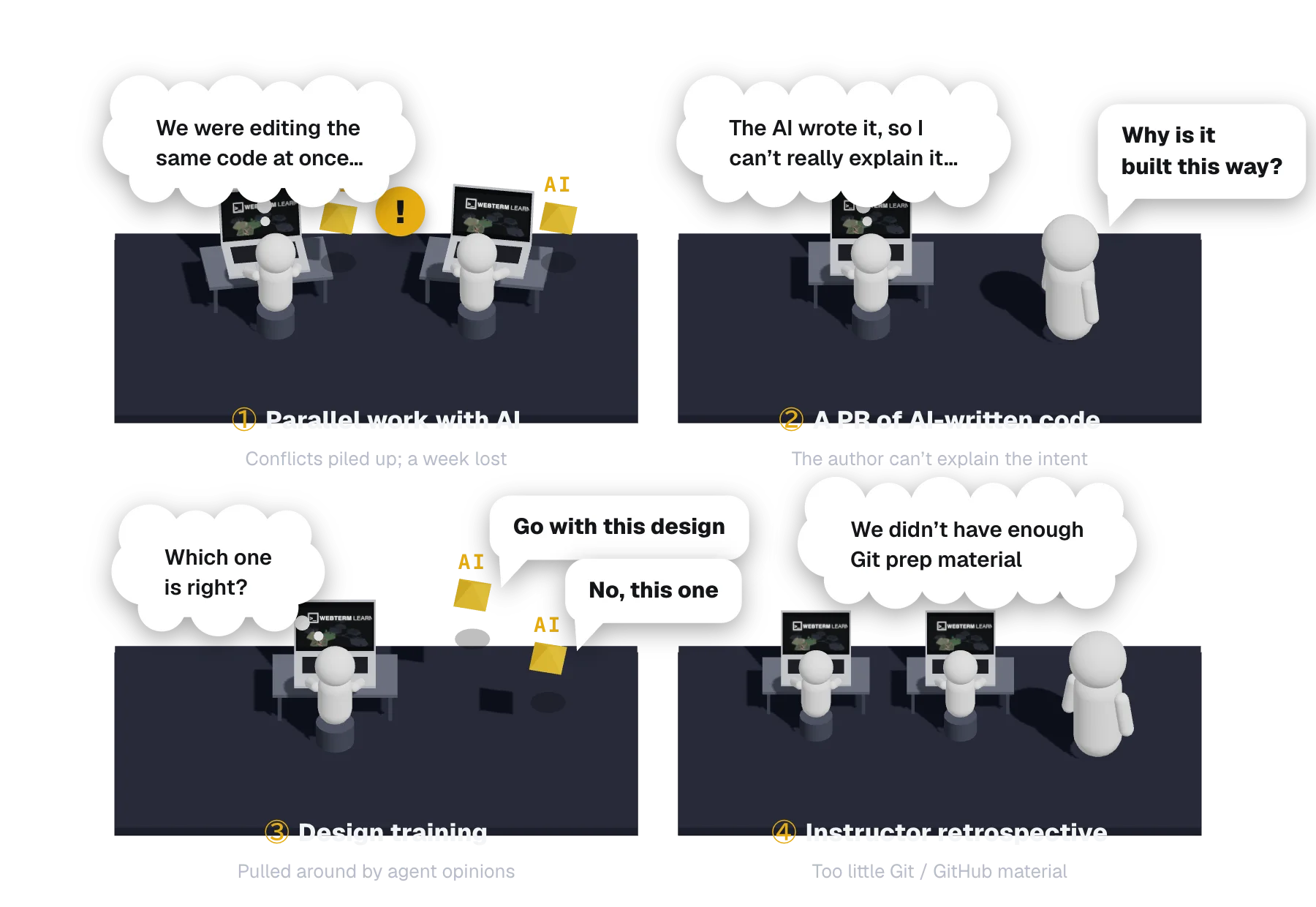
- ①Cloud Ace, 2025 training report by a new graduate
- ②DeNA, 2025 retrospective by a new-graduate team
- ③GMO Pepabo, 2026 new-graduate training report (design training)
- ④NTT Communications, instructors’ and mentors’ retrospective on new-hire training (held in November 2021)
None of these are about operating a tool. In each case, what was tested was whether trainees could see what was going on and explain it themselves.
Implications for training design
- Decide how far Git training goes. All five companies cover resolving conflicts. Decide whether recovery and history cleanup belong in training or are left to on-the-job learning after placement
- If the shell is not a subject, make it a prerequisite. Even companies without a dedicated subject write the rest of their material assuming command-line skills. Everyone needs to reach the same baseline before joining or early in training
- If you allow generative AI, pair it with the fundamentals to evaluate its output. Companies of every type emphasized the foundational knowledge needed to judge whether AI output is sound
Methodology
For each company, the most recent year with published materials or a training write-up was selected, and its slides, GitHub repositories, and tech blog posts were read. For each subject, the analysis recorded what it covered, how it was taught, what it assumed, and how it handled generative AI. Every fact quoted in this article was checked against the primary source (as of September 2026). Published materials usually cover only part of a program and exclude internal-only sessions. Personal retrospectives by new hires do not represent official company policy, and the sources say so where they are quoted.
The 19 companies whose curricula were tallied, with the year covered:
- Recruit2026
- MIXI2026
- Cybozu2026
- NIFTY2026
- GMO Pepabo2026
- RAKUS2026
- Bengo4.com2026
- Future2026
- Safie2026
- Everyleaf2026
- Dwango2025
- Geniee2025
- FLINTERS2025
- Cloud Ace2025
- Medley2025
- BrainPad2025
- GMO Internet Group2025
- WILLGATE2024
- CoDMON2023
Closing
Basic shell and Git skills are increasingly a prerequisite for training. WebTerm Learn lets people build those skills in the browser, at their own pace. The Terminal and Git courses have hands-on exercises from the first lesson. For team training, see WebTerm Learn for teams.